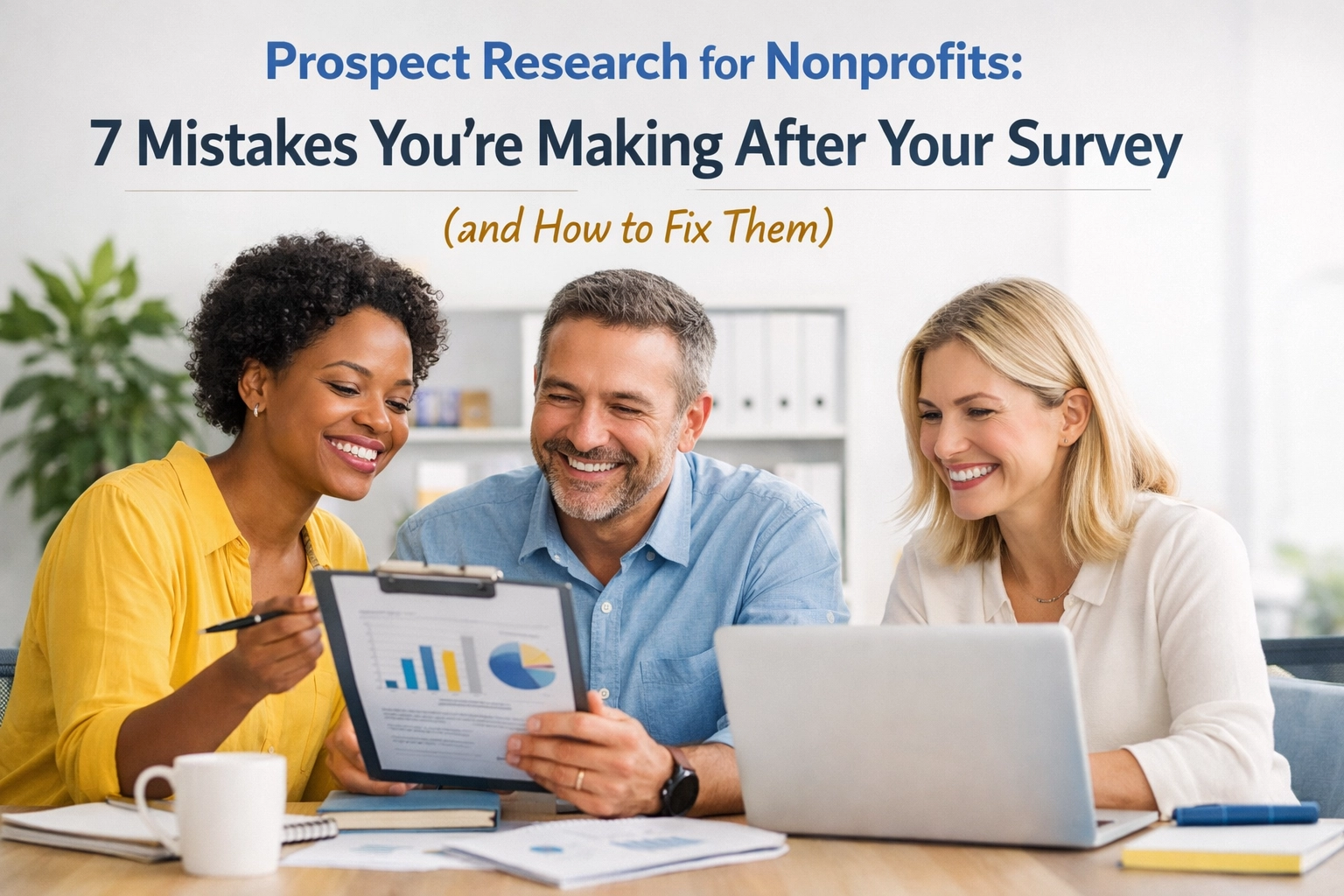
Prospect Research for Nonprofits: 7 Mistakes You’re Making After Your Survey (and How to Fix Them)
Congrats! You just wrapped up your donor survey. You've got responses, data points, and a spreadsheet that's making your head spin. Now what?
Here's the thing most nonprofits get wrong: the survey isn't the finish line, it's the starting gate. The real magic happens in what you do after collecting all that information. And unfortunately, that's exactly where most organizations fumble the ball.
Let's talk about the seven biggest mistakes you're probably making when it comes to prospect research after your survey wraps up, and more importantly, how to fix them so you can turn those "maybes" into actual major gifts.
Mistake #1: Treating All Survey Responses Equally
You got 500 responses to your survey. Awesome! But here's the reality check: not all of those responses deserve the same level of attention from your team.
The Fix: Prioritize based on wealth indicators AND sentiment. Someone who expressed high interest in your mission but has limited capacity? They're a fantastic monthly donor prospect. Someone who gave lukewarm responses but has significant wealth markers? They might need more cultivation, but they're worth the investment.
This is where AI-powered prospect research tools become your best friend. Instead of manually combing through responses trying to figure out who to call first, modern fundraising technology can instantly cross-reference survey data with wealth screening information, giving scores, and engagement history to create a prioritized outreach list.

Mistake #2: Ignoring Your Own Database Gold Mine
You spent all this money on the survey, analyzed the external responses, and somehow forgot to look at the treasure chest you've been sitting on the whole time, your existing donor database.
The Fix: Run a wealth screening on your current supporters who responded to the survey. You'd be shocked how many people already in your database have major gift capacity but have never been asked. They're already engaged (hello, they took your survey!), they already care about your mission, and they already trust you enough to share their opinions.
Match survey responses against your CRM. Look for donors who've been giving $100 annually for five years but have the capacity to give $10,000. Those folks should be at the top of your cultivation list.
Mistake #3: Jumping Straight to "The Ask"
Survey says someone's interested in your new program? Great! Time to call them and ask for $50,000, right?
Wrong. So, so wrong.
The Fix: Use survey data to start conversations, not close deals. If someone indicated interest in planned giving on your survey, don't immediately pitch them on including you in their will. Instead, invite them to a planned giving education workshop. Send them relevant content. Build the relationship first.
Think of your survey as a sophisticated conversation starter. It told you what topics interest each prospect, now use that intelligence to cultivate strategically rather than soliciting prematurely.

Mistake #4: Talking Instead of Listening (Still)
The survey gave people a chance to share their thoughts in writing. That's step one. But when you finally get them on the phone or meet them face-to-face, are you actually listening, or are you just waiting for your turn to talk?
The Fix: Use the survey data as a jumping-off point, then shut up and listen. "I noticed you mentioned environmental sustainability in your survey response, I'd love to hear more about why that resonates with you."
Then actually let them answer. Resist the urge to immediately launch into your pitch. The more they talk, the more you learn about their motivations, values, and giving capacity. Plus, people are way more likely to give when they feel heard rather than sold to.
Mistake #5: Forgetting to Follow Up on "Not Now"
Someone indicated they're not interested in making a larger gift "at this time." Most organizations read that as "never" and move on.
The Fix: "Not now" isn't "no", it's "ask me later." Set up a systematic follow-up process for prospects who indicated interest but not readiness. Maybe they're waiting for a bonus, dealing with a family situation, or just need more information.
Use AI-powered automation to keep these prospects warm without overwhelming your team. Schedule quarterly check-ins, send relevant content, and keep them engaged with your mission. When their circumstances change, you want to be top of mind.

Mistake #6: Analyzing Data in a Vacuum
You're looking at survey responses on your laptop. Your major gifts officer has wealth screening data in a different system. Your events coordinator has engagement metrics in yet another platform. And nobody's talking to each other.
The Fix: Integrate your data sources. The most powerful prospect research happens when you combine survey sentiment with wealth indicators, giving history, event attendance, volunteer engagement, and communication preferences all in one place.
Modern fundraising platforms can aggregate this information automatically, using AI to identify patterns you'd never spot manually. That quiet donor who always attends your events, responded enthusiastically to your survey, and just sold their business? That's your next major gift prospect, but only if you're connecting the dots.
Mistake #7: Treating AI Like a Magic Button
Speaking of AI, let's address the elephant in the room. Yes, AI-powered prospect research tools are incredible. No, they don't replace human judgment and relationship-building.
The Fix: Use AI to do what it does best: process massive amounts of data, identify patterns, prioritize prospects, and automate routine tasks. But use humans for what they do best: building genuine relationships, understanding nuanced motivations, and making judgment calls that require emotional intelligence.
The winning combination? AI handles the "who" and "when": who to contact and when to reach out. Humans handle the "how" and "why": how to approach each unique individual and why they should support your mission.

Turning Survey Data Into Major Gifts
Here's the bottom line: your survey collected incredible information about donor intentions, interests, and inclinations. But intention doesn't equal action. Interest doesn't equal investment. And inclination doesn't automatically become impact.
The gap between survey responses and actual gifts is bridged by smart prospect research, strategic cultivation, and thoughtful relationship-building. When you avoid these seven common mistakes, you transform that survey data from interesting statistics into actionable intelligence that drives real results.
Stop letting valuable prospect insights sit unused in a spreadsheet. Stop treating all survey responses the same. And stop trying to do manually what technology can handle automatically, freeing you up to do what really matters: building authentic relationships with the people who care about your cause.
Your survey told you who's interested. Now it's time to use smart prospect research to figure out who's ready, who's capable, and who just needs the right cultivation approach to go from "maybe" to "major donor."
Because at the end of the day, the goal isn't just to gather data: it's to turn that data into donations that change the world.