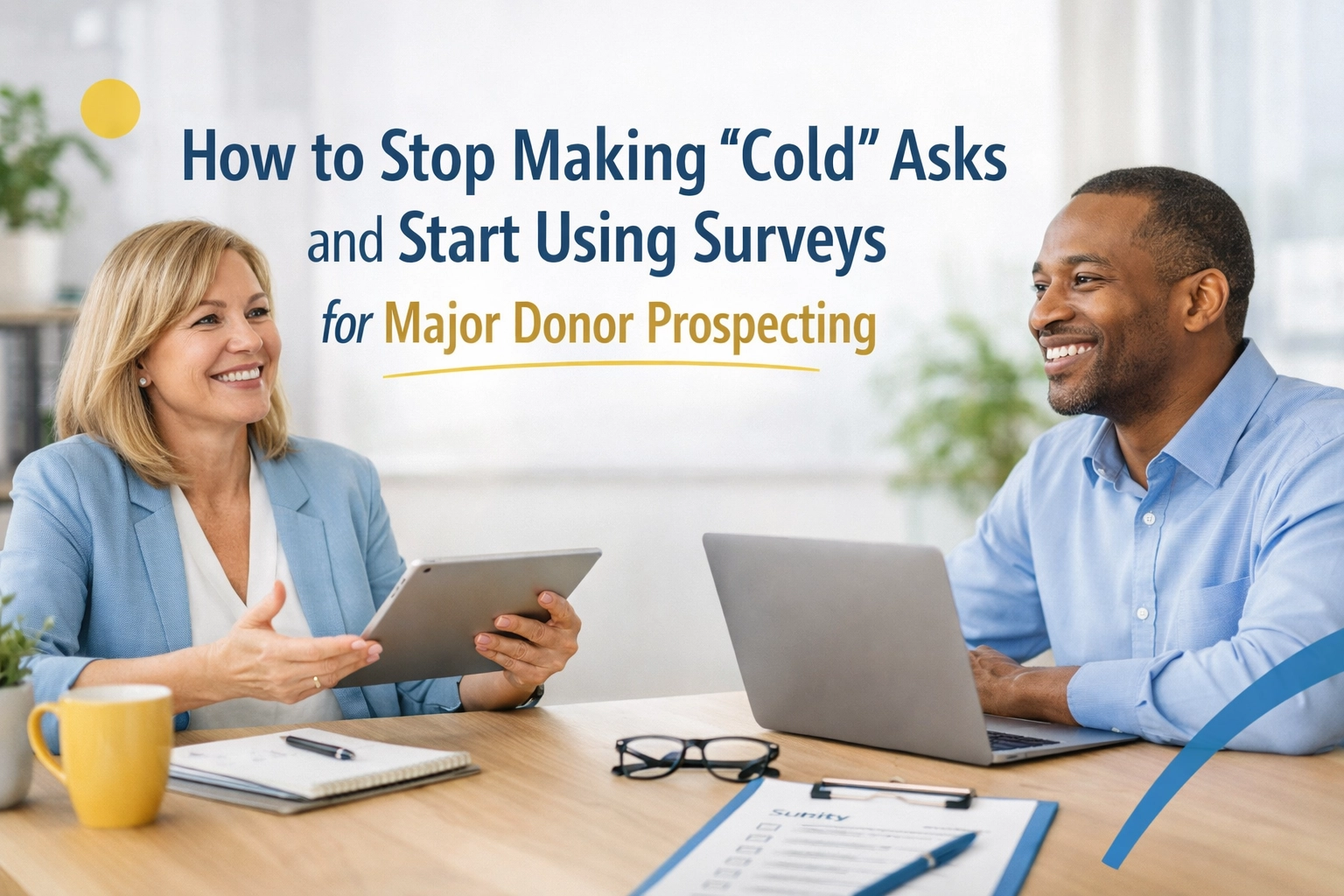
How to Stop Making ‘Cold’ Asks and Start Using Surveys for Major Donor Prospecting
Major gift fundraising has increasingly shifted away from “cold” asking and toward relationship-based cultivation, because cold outreach has been widely associated with lower conversion rates, higher staff time costs, and inconsistent donor experiences. In the current environment, characterized by crowded digital channels, rising donor expectations, and heightened sensitivity to irrelevant outreach, major donor prospecting has become crucial, yet it has also become more complex. Within this complexity, donor engagement surveys can be leveraged as a practical, data-informed bridge between broad-based fundraising and major gift conversations.
When surveys are implemented intentionally, they can be utilized to identify interest, intent, readiness, and preferred engagement pathways, thereby enabling organizations to establish warmer, more credible next steps. Instead of guessing who might be ready for a major gift conversation, organizations can be developing a pipeline based on observable signals, documented preferences, and self-reported priorities. This approach can be repeated and scaled, and it can be integrated with existing CRM workflows, segmentation, and major gift qualification processes.
Why “cold” asks keep underperforming (and why they keep happening anyway)
Cold asks tend to underperform because they are often built on incomplete information. Capacity indicators might be present, but philanthropic motivation, issue alignment, and relationship readiness are frequently unknown. Even where wealth screening or external research has been conducted, organizations are still left with a critical gap: whether the prospective donor actually cares about the mission enough to engage in a major gift conversation right now.
Cold asking also continues to happen for operational reasons. Fundraising teams are frequently pressured to “fill the pipeline,” and lists of high-capacity names can create the illusion of readiness. As a result, outreach can be initiated before any meaningful engagement has been established. While referrals and networks can be leveraged to warm introductions, that path is not always available at scale. Similarly, screening the existing donor base is frequently recommended as a primary focus before launching broader outreach; however, screening alone is not sufficient if engagement data is not being captured and operationalized.
Surveys can be utilized to close this gap by creating a low-friction way for supporters to raise their hand, express their priorities, and signal what type of relationship they actually want.
Surveys as “warm prospecting” at scale
Warm prospecting has been emphasized in modern fundraising because connected prospects generally respond at higher rates and can be cultivated more predictably. Surveys support warm prospecting by converting passive engagement into explicit, structured data. Rather than assuming that a donor’s interest can be inferred from a single gift or a single event, surveys enable organizations to validate assumptions and document donor-specific context.
A well-constructed survey can be positioned as listening, not selling. That framing matters, because supporters are often more willing to provide information when it is clearly being requested for mission alignment and improved stewardship. In practical terms, surveys can:
- Identify program affinities and priority issues
- Surface readiness signals for deeper involvement
- Capture communication preferences and contact permissions
- Reveal giving motivations (impact, recognition, community, legacy)
- Segment supporters into next-best-action pathways
When these outputs are consistently utilized, major donor prospecting becomes less about cold outreach and more about responding to expressed intent.

What to survey for: the four data types that reduce “coldness”
Organizations frequently gather demographic or satisfaction data, but major donor prospecting requires a more targeted structure. The most useful survey frameworks incorporate four categories of information that can be repeatedly leveraged for cultivation.
1) Mission alignment and program interest
Supporters can be asked to rank issue areas, programs, or initiatives. This can be operationalized immediately: outreach can be framed around what the supporter has already said matters most. This also enables organizations to match prospects with the most relevant staff member, board member, or program leader for follow-up.
Examples of prompts
- “Which areas of our work are most meaningful to the respondent?”
- “Which outcomes should the organization prioritize over the next 12 months?”
2) Engagement preference and relationship readiness
A significant portion of “cold” asking occurs because relationship readiness is assumed. Surveys can be leveraged to determine how people prefer to engage and how open they are to deeper conversation.
Examples of prompts
- “Which ways would the respondent like to stay involved (updates, events, volunteering, brief call)?”
- “Would the respondent be open to a conversation about the organization’s priorities?”
3) Capacity-adjacent indicators (without making it awkward)
Direct wealth questions often reduce response quality, but “capacity-adjacent” questions can be utilized to infer potential without being intrusive. These questions can be framed around philanthropic planning, employer matching, donor-advised funds, and planned giving interest.
Examples of prompts
- “Does the respondent’s employer offer a matching gift program?”
- “Has the respondent already used a donor-advised fund (DAF) for charitable giving?”
- “Would the respondent like information about including nonprofits in long-term plans?”
4) Timing and urgency signals
Major gifts are frequently driven by timing, tax planning, life events, or a desire to solve a specific problem within a specific window. Surveys can surface this, enabling organizations to avoid premature asks and instead establish appropriately timed next steps.
Examples of prompts
- “When would the respondent like to hear about opportunities to make a bigger impact?”
- “Which timeframe is most realistic for deeper involvement (30/60/90 days)?”
How to structure a donor engagement survey for major donor prospecting
Survey performance is heavily influenced by length, clarity, and positioning. The objective is not to collect everything; it is to collect enough to create a warm, permission-based next step. Most organizations will see higher completion rates with 6–10 questions, with optional follow-ups for those who indicate openness to deeper involvement.
A high-performing structure can be implemented as follows:
- Start with mission interest (easy, non-threatening)
- Add engagement preference (relationship readiness)
- Include one capacity-adjacent question (light qualification)
- Ask for permission to follow up (consent-based next step)
- Collect contact confirmation (reduce CRM errors and bounces)
A simple survey outline (copy-ready)
- Which parts of our work matter most to the respondent? (multi-select)
- What prompted the respondent to support the organization? (single-select)
- How would the respondent prefer to hear from the organization? (multi-select)
- Would the respondent be open to a brief conversation about upcoming priorities? (yes/no/maybe)
- Which opportunities interest the respondent? (impact updates / event / tour / volunteer / strategic conversation / legacy options)
- Would the respondent like information about giving through a DAF or stock? (yes/no)
- Best email/phone to use for updates (prefill if possible)
This structure can be utilized repeatedly and refreshed annually, enabling trend analysis and pipeline development over time.
Turning survey responses into a major donor shortlist (without overcomplicating it)
Survey data only reduces “coldness” if it is operationalized. Organizations can be utilizing a basic scoring and segmentation approach that converts responses into clear next actions.
A practical “warmth score” model
A simple model can be implemented with three pillars:
- Interest score (alignment and specificity)
- Engagement score (willingness to meet, attend, or volunteer)
- Capacity signals (DAF usage, stock giving interest, matching, legacy curiosity)
Each pillar can be scored 0–3 and combined for a 0–9 total. The objective is not predictive perfection; the objective is consistent triage.
Suggested action bands
- 0–3: Stewardship and digital nurture
- 4–6: Mid-level cultivation and targeted invitations
- 7–9: Major gift qualification pathway (personal outreach within 5–10 business days)
This can be integrated into the CRM via tags, custom fields, and tasks, thereby reducing staff friction and ensuring follow-through.

What the follow-up should look like (so it does not feel like a bait-and-switch)
A common concern is that surveys might be perceived as a pretext for an ask. That risk can be reduced by structuring follow-up as a response to what was shared, not an immediate solicitation. The first touch should be a confirmation of listening and an offer of value (insight, access, or relevance).
Follow-up templates (relationship-first)
If the respondent said “yes” to a conversation
- Subject: Following up on the priorities the respondent shared
- Message: Thank the respondent, reference the selected program area, and offer two short time windows for a brief call focused on organizational priorities and what the respondent cares most about.
If the respondent said “maybe”
- Subject: A quick resource based on the respondent’s interests
- Message: Provide a short impact update or a 1-page brief, then ask whether a short call would be helpful later in the month.
If the respondent said “no” but showed strong interest
- Subject: Thanks for sharing what matters most
- Message: Confirm communication preferences and offer targeted updates related to the chosen program area, without implying a meeting.
For organizations that want a deeper framework for converting hesitant interest into genuine major gift momentum, additional guidance can be found here: https://donationaccelerator.com/beyond-the-survey-how-to-turn-maybe-into-a-major-gift
Distribution: where surveys actually get responses
Surveys can be utilized across channels, but the highest response rates tend to come from audiences that already have some connection. This aligns with the broader industry recommendation to prioritize warm prospecting and screening within an existing base before relying on true cold outreach.
High-performing distribution options include:
- Post-donation thank-you pages and receipts (for recent donors)
- Email segments (lapsed donors, repeat donors, volunteers, event attendees)
- Event follow-up messages (within 48 hours)
- SMS invitations for high-engagement supporters
- Phone-based stewardship calls where survey questions are asked conversationally
Surveys can also be layered into donor journeys. For example, a supporter who attends an event can be sent a short “what did the respondent care most about?” survey, and those who select “strategic conversation” can be routed to a major gifts officer for qualification.
Common survey mistakes that keep asks cold
Even well-intended surveys can fail to reduce cold outreach if they are implemented without clear operational guardrails. The following mistakes are frequently associated with low completion rates and weak downstream conversion.
Making it too long
Long surveys tend to reduce completion, especially on mobile devices. A short survey can be used first, with optional deeper questions for those who opt in.
Asking leading questions that sound like an ask
When questions are written as pre-solicitation, trust can be reduced. Listening language should be utilized, and any giving-related items should be framed as preference-based (e.g., “Would the respondent like information about…”).
Collecting data without assigning ownership
If a survey generates “yes” responses and nobody follows up within a defined timeframe, the organization’s credibility can be weakened. A service-level expectation should be established (for example: “yes” responses receive outreach within 5–10 business days).
Treating survey responses as static
Interests change. Surveys can be repeated annually, and results can be refreshed after major campaigns, events, or program launches.

Integrating surveys into a modern major donor pipeline
For surveys to consistently replace cold asking, they should be embedded into an operating system rather than treated as a one-off project. This system typically includes:
- A survey cadence (quarterly micro-surveys or annual engagement surveys)
- CRM fields and tags for interest, engagement preference, and follow-up permission
- Automated routing so that high-warmth respondents are flagged immediately
- A stewardship content library aligned to major program areas
- A qualification pathway (discovery call → tailored follow-up → invitation to invest)
At Donation Accelerator, this type of survey-to-action workflow can be supported by fundraising technology that is oriented around turning engagement signals into practical next steps, thereby increasing consistency and reducing reliance on cold outreach. Additional fundraising strategy content can be explored here: https://donationaccelerator.com/blog
A repeatable playbook: from survey to major gift conversation in 30 days
A simple 30-day implementation can be utilized by many organizations without requiring a major staffing overhaul.
Week 1: Build and segment
- Build a 6–10 question engagement survey
- Segment the audience (repeat donors, lapsed donors, event attendees, volunteers)
- Prepare two or three short follow-up email templates based on “yes/maybe/no”
Week 2: Launch and monitor
- Send the survey to the warmest segments first
- Track completion rate and drop-off points
- Ensure CRM tagging is functioning and responses are being captured accurately
Week 3: Follow up in priority order
- Outreach to “yes” respondents (schedule discovery calls)
- Nurture “maybe” respondents with targeted impact briefs
- Steward “no” respondents according to preferences
Week 4: Conduct discovery calls and create next steps
- Use discovery calls to confirm interests, philanthropic motivations, and engagement style
- Document next steps in the CRM
- Route to portfolio assignment if appropriate, or continue mid-level cultivation
This playbook can be repeated after key campaign moments, after events, or during year-end planning, enabling organizations to continually refresh and expand the major donor pipeline without resorting to cold asking.
The core shift: from guessing to listening, from cold to permission-based
Major donor prospecting has become crucial, and it has also become increasingly reliant on accurate, timely, and actionable data. Surveys can be leveraged to replace guesswork with structured listening, and they can be utilized to create consent-based pathways into major gift conversations. When organizations are implementing surveys as part of a broader engagement system: capturing interest, readiness, and preference signals: major gifts can be pursued with greater credibility, higher efficiency, and improved donor experience.
In other words, the most effective alternative to cold asking is not merely more outreach; it is more listening, more segmentation, and more operational follow-through: implemented consistently, and repeated over time.