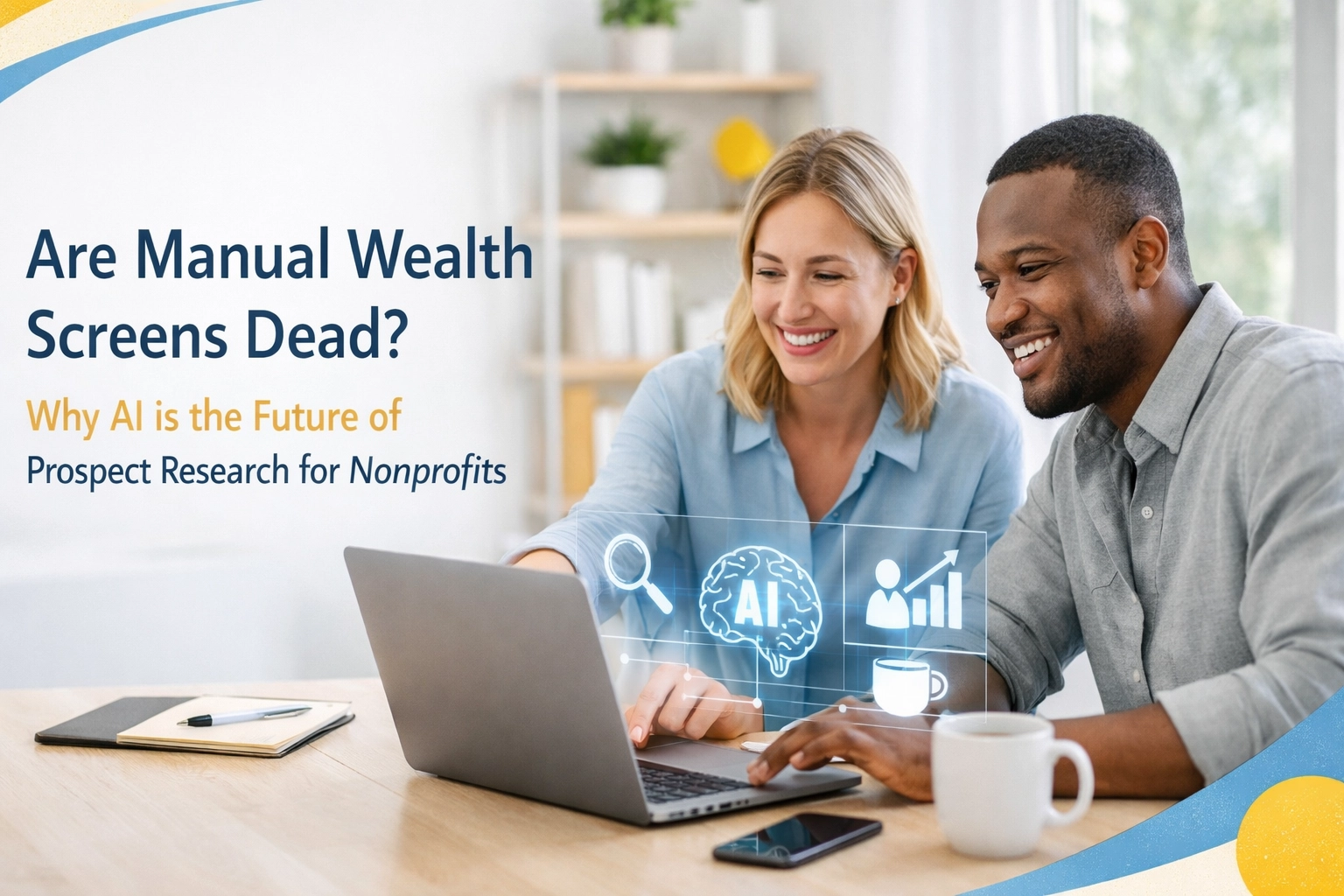
Are Manual Wealth Screens Dead? Why AI is the Future of Prospect Research for Nonprofits
If you’ve spent more than five minutes in the world of nonprofit fundraising, you know the "spreadsheet stare." It’s that glazed-over look development officers get after spending six hours scrolling through property tax records, LinkedIn profiles, and outdated "rich lists" trying to figure out if a donor has the capacity to give a major gift.
For decades, manual wealth screening was the gold standard. You’d hire a researcher (or do it yourself), pull a few hundred names from your database, and cross-reference them with public records. It was slow, it was expensive, and by the time you finished the report, the data was already starting to grow whiskers.
But the world has changed. In 2026, the speed of information is faster than ever, and donor behavior is shifting in ways that a simple zip-code-based wealth score can’t capture.
So, the big question is: Are manual wealth screens dead?
The short answer is: Not quite, but they’re definitely on life support. The future of finding your next major donor isn’t in a dusty manual process; it’s in Artificial Intelligence. At Donation Accelerator, we’re seeing a massive shift in how organizations of all sizes find, vet, and engage with high-capacity supporters.
Let’s dive into why AI is flipping the script on prospect research and why this is actually the best news small nonprofits have heard in years.
The Problem with the "Old Way"
Traditional wealth screening usually looks at three things: real estate holdings, public stock ownership, and past political giving. While those are great indicators of wealth, they don’t tell the whole story.
Manual screening often suffers from three major flaws:
- The Stale Data Trap: Wealth is fluid. Someone might sell a business or inherit assets on a Tuesday, but your manual screen from last year won't reflect that.
- The "Capacity vs. Propensity" Gap: Just because someone can give $50,000 doesn’t mean they want to give it to you. Manual screens focus on the "can," but often miss the "why."
- The Cost Barrier: For a long time, high-level prospect research was a luxury reserved for Ivy League universities and massive hospital foundations. Smaller nonprofits were left guessing.

Enter AI: The Great Equalizer
The most exciting thing about AI-powered fundraising is how it levels the playing field. You no longer need a department of ten researchers to uncover high-value opportunities.
AI doesn't just look at how much money someone has in the bank; it looks at behavioral signals. It analyzes how donors interact with your emails, how often they visit your website, and what specific causes they talk about online. It’s like having a researcher who works 24/7, never sleeps, and reads every public data point on the internet simultaneously.
By utilizing donor relationship manager software, even a one-person development team can get the same level of insight that used to require a massive budget.
Real-Time Insights vs. Historical Snapshots
One of the biggest trends we’re seeing in 2026 is the move toward Real-Time Wealth Intelligence. Instead of doing a "bulk screen" once a year, AI-powered systems constantly monitor your database.
If a donor suddenly sells a large block of shares or buys a second home, the AI flags it immediately. This allows your team to reach out at the exact moment a donor might be thinking about their tax strategy or their legacy. This kind of timing is impossible with manual research.
Why Small Nonprofits are Winning with AI
In the past, the "Big Guys" dominated because they had the best data. But AI is a massive "force multiplier."
Smaller organizations are often more agile. When they use tools like our planned giving accelerator, they can identify donors who have deep loyalty to the cause but might not show up on a traditional wealth screen as "rich."
Remember, some of the most consistent major donors aren't the ones with the private jets; they’re the retired teachers or small business owners who have been giving $50 a month for twenty years. AI is incredible at finding these "hidden gems", donors with high affinity who are ready to step up their commitment.

Beyond the Spreadsheet: Understanding Donor Behavior
The "Future of Prospect Research" isn't just about finding out who has money; it's about understanding how they want to be treated.
Modern AI doesn’t just output a "Wealth Score of 5." It provides a Engagement Score. It tells you:
- What time of day this donor is most likely to answer a call.
- What specific programs within your nonprofit they are most passionate about.
- Whether they prefer a formal letter or a casual text.
This is where the magic happens. When you combine wealth data with behavioral analysis, your outreach stops feeling like a "solicitation" and starts feeling like a "conversation."
If you want to see how this works in action, our virtual agent call campaigns use these insights to reach donors in a way that feels personal and respectful, rather than robotic.
Is there still a place for humans?
Absolutely. In fact, AI makes the human element more important.
When you stop spending 80% of your time finding donors, you can spend 100% of your time building relationships with them. AI handles the "detective work," but the human fundraiser handles the "heart work."
The goal of AI in prospect research isn't to replace the development officer; it’s to make sure that when the development officer sits down for coffee with a prospect, they are sitting with the right person, at the right time, for the right reason.

Trends to Watch in 2026 and Beyond
As we move further into this AI-driven era, here are a few trends that every nonprofit leader should have on their radar:
- Hyper-Personalization at Scale: Using AI to send 10,000 different donors 10,000 different messages based on their specific wealth profile and interests.
- Predictive Retention: AI can now predict which donors are at risk of "churning" (stopping their donations) months before it happens, allowing you to intervene.
- Automated Wealth Triggers: Systems that automatically alert a gift officer when a prospect’s company goes through an IPO or a major merger.
- Omni-channel Research: Moving beyond just email and mail to understand how donors interact with website chatbots and social platforms.
How to Get Started (Without the Headache)
If you’re still relying on manual screens, don't worry, you don't have to overhaul your entire department overnight. The best way to start is by integrating AI tools into your existing workflow.
Start by looking at your current CRM. Is it just a digital Rolodex, or is it working for you? At Donation Accelerator, we specialize in making these advanced technologies accessible. Whether you’re interested in virtual agent campaigns or simply want to clean up your donor data, the transition is easier than you think.

The Verdict: Manual is Out, Intelligence is In
Manual wealth screens aren't "dead" in the sense that they've disappeared, but they are no longer a competitive advantage. In a world where your donors are being bombarded with requests from every direction, you can't afford to be slow.
AI gives you the gift of time and the power of precision. It allows you to focus your energy on the people who are most likely to say "yes" and make a meaningful impact on your mission.
The future of prospect research isn't a bigger spreadsheet: it's a smarter one.
Are you ready to see what AI can do for your organization’s bottom line? We’d love to show you how we’re helping nonprofits transform their fundraising results. Feel free to reach out to us or check out our services page to learn more.
Let’s stop digging through data and start growing your impact!