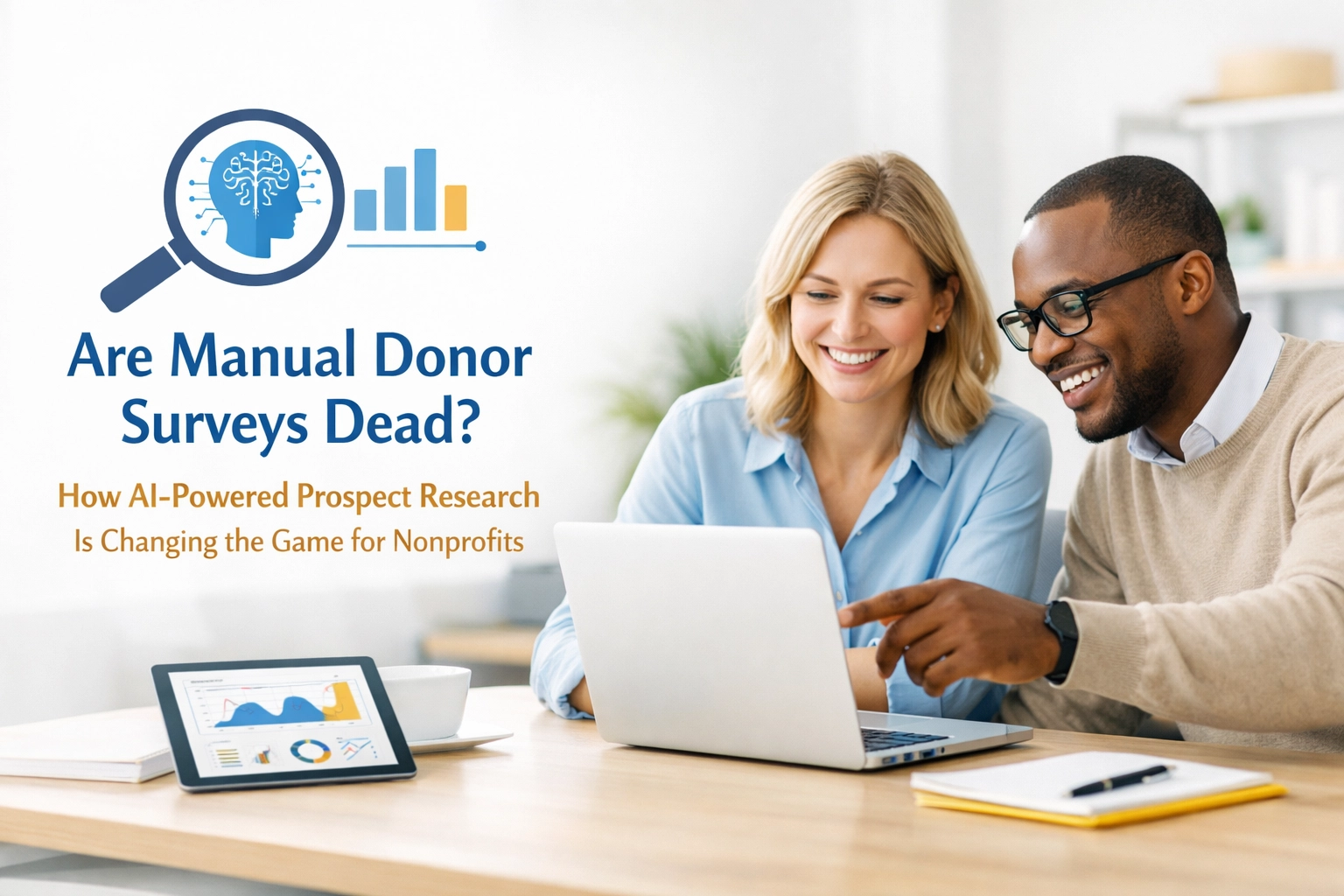
Are Manual Donor Surveys Dead? How AI-Powered Prospect Research Is Changing the Game for Nonprofits
Let's get real for a second. If you've spent countless hours crafting the perfect donor survey, analyzing responses in spreadsheets, and trying to figure out who's most likely to give again… you're not alone. Manual donor research has been the backbone of nonprofit fundraising for decades. But here's the thing: the game is changing fast.
So, are manual donor surveys actually dead? Not quite. But they're getting a serious upgrade, and if your nonprofit isn't paying attention, you're missing out on some pretty incredible opportunities.
The Old Way of Doing Things (And Why It's Getting Harder)
Traditional donor surveys have always been a solid strategy. You send out questionnaires, wait for responses, manually analyze the data, and hope you're asking the right questions. The problem? Most donors don't respond. And even when they do, you're only scratching the surface of what they're willing to share.
According to recent data, typical survey response rates hover around 10-30% for nonprofits. That means 70-90% of your donor base remains a mystery. You're making decisions based on a fraction of your actual supporter community, which is like trying to complete a puzzle with most of the pieces missing.
Plus, let's be honest: analyzing survey data manually is time-consuming. Small to mid-sized nonprofits often don't have dedicated research teams, so this work falls on already-stretched development staff. By the time you've compiled the results and created an action plan, donor preferences may have already shifted.

Enter AI-Powered Prospect Research
Here's where things get interesting. AI-powered prospect research isn't about replacing your surveys: it's about supercharging your entire donor intelligence operation. Think of it as having a tireless research assistant who can analyze thousands of data points in seconds, spot patterns you'd never notice manually, and predict donor behavior with surprising accuracy.
The technology pulls from multiple sources: giving history, engagement patterns, wealth indicators, philanthropic interests, and even public records. Instead of waiting for donors to tell you what they care about, AI helps you discover insights based on actual behavior.
And we're not talking science fiction here. Real nonprofits are seeing real results. Take Mercy Home for Boys & Girls as an example. When they deployed AI models to identify which one-time donors would be most receptive to monthly giving appeals, they saw a jaw-dropping 1,994% higher conversion rate compared to traditional marketing approaches. That's not a typo: nearly 2,000% better results.
How AI Levels the Playing Field for Smaller Nonprofits
One of the most exciting developments? AI is democratizing prospect research. Tools that were once only accessible to large institutions with massive budgets are now available to organizations of all sizes.
Previously, comprehensive prospect research required hiring expensive consultants or subscribing to premium wealth screening databases. Smaller nonprofits simply couldn't compete with their larger counterparts when it came to identifying major gift prospects or understanding donor capacity.
AI changes that equation. Modern platforms can:
- Automatically score donor likelihood to give based on engagement patterns, not just wealth capacity
- Identify hidden major gift prospects in your existing donor base who might fly under the radar
- Predict which donors are at risk of lapsing before they actually disappear
- Personalize communications at scale without requiring a massive marketing team

The best part? These systems get smarter over time. Every interaction, every gift, every email open feeds back into the model, creating increasingly accurate predictions about what resonates with your specific donor community.
The Automation Advantage
Let's talk about donor behavior analysis. Traditional surveys give you snapshots: how donors felt at one particular moment when they filled out your form. AI-powered systems provide continuous monitoring and analysis.
Modern fundraising platforms track dozens of behavioral signals: email engagement, website visits, event attendance, social media interactions, giving frequency, gift size trends, and response to specific appeals. These data points create a dynamic profile of each donor that updates in real-time.
For instance, if a long-time monthly donor suddenly stops opening your emails and misses a payment, an AI system can flag this immediately and trigger a personalized intervention: before you lose them entirely. No survey required.
Or imagine identifying which donors in your database have the capacity and inclination for planned giving, based on age, giving history, and engagement patterns. Instead of surveying your entire list (and getting minimal responses), you can focus your planned giving conversations on the most promising prospects.
What This Means for Your Survey Strategy
So should you abandon donor surveys altogether? Absolutely not. But you should evolve how you use them.
Think of AI as handling the "what" and "when" while surveys help you understand the "why." AI tells you which donors are most engaged, most likely to upgrade, or showing warning signs of disengagement. Surveys help you understand the motivations and emotional connections behind those behaviors.
The winning strategy? Use AI insights to make your surveys more strategic:
- Survey your most engaged donors to understand what's working and replicate it
- Target at-risk donors identified by AI with specific retention-focused questions
- Focus on qualitative feedback rather than trying to gather basic behavioral data you can already extract automatically
- Personalize survey questions based on AI-generated donor segments

Remember, 48% of donors still cite email as their preferred communication channel, and 33% say email most inspires them to give. Direct communication remains crucial: AI just helps you be smarter about who you're talking to and what you're saying.
The Integration Imperative
Here's a critical point: the real power comes from integration. AI-powered prospect research works best when it's connected to your entire fundraising ecosystem: your CRM, your email platform, your giving forms, your website analytics.
Leading nonprofits are moving away from fragmented tools and embracing integrated platforms that leverage donor data across all touchpoints. This creates a unified view of each supporter and enables the kind of personalization that donors increasingly expect.
Think about your own experience as a consumer. When Netflix recommends a show, or Amazon suggests a product, you've come to expect that level of personalization. Your donors aren't any different. They notice when communications feel generic, and they respond to messages that demonstrate you understand their interests and preferences.
Getting Started Without Getting Overwhelmed
If you're feeling excited but also slightly overwhelmed, that's normal. Implementing AI-powered prospect research doesn't mean overhauling your entire operation overnight.
Start small:
- Audit your current data to understand what information you're already collecting
- Identify your biggest pain point (is it donor retention? Major gift identification? Personalization at scale?)
- Explore AI-powered fundraising solutions that address that specific challenge
- Test and learn with a subset of your database before rolling out organization-wide
The nonprofits seeing the most success aren't necessarily the ones with the biggest budgets or the most sophisticated tech stacks. They're the ones willing to experiment, learn from the data, and adapt their strategies based on what's actually working.
The Bottom Line
Manual donor surveys aren't dead: they're evolving. AI-powered prospect research isn't replacing human insight; it's amplifying it. Together, they create a powerful combination that helps nonprofits of all sizes build deeper relationships with donors and drive better fundraising results.
The organizations thriving in today's fundraising landscape are the ones embracing both technology and personal connection. They're using AI to work smarter, not harder, freeing up time for the meaningful conversations and relationship-building that no algorithm can replicate.
Your donors are already living in an AI-powered world. The question is: will your nonprofit meet them there?