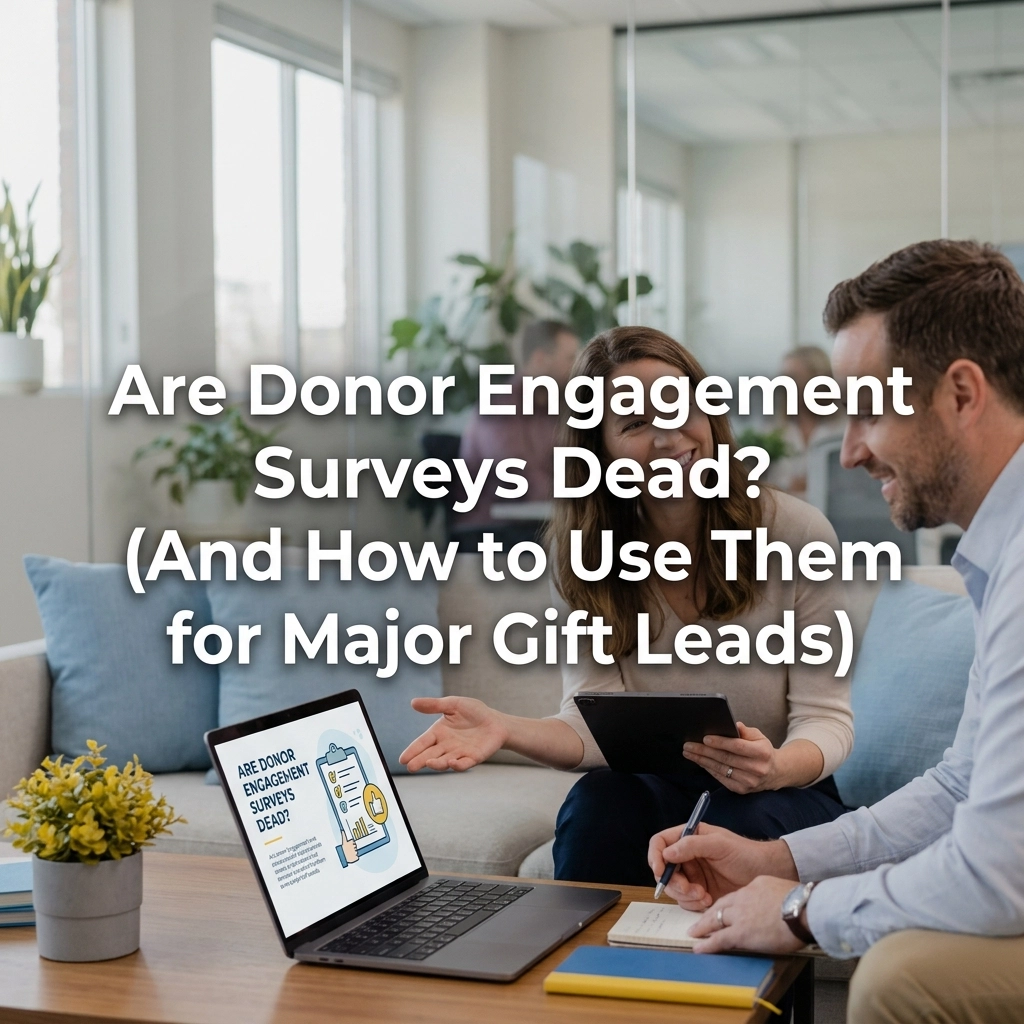
Are Donor Engagement Surveys Dead? (And How to Use Them for Major Gift Leads)
Let’s be real for a second: your inbox is probably a graveyard of unanswered "We value your feedback!" emails. We’ve all been there. You buy a pair of socks online, and suddenly you’re being asked to rate your "customer journey" on a scale of 1 to 10. It’s exhausting.
So, when we talk about donor engagement surveys, it’s natural to wonder if they’ve gone the way of the fax machine. Are they dead? Are they just another piece of digital noise that donors delete before the page even loads?
The short answer is: No, they aren't dead. But the old way of doing them: the "set it and forget it" method: is definitely on life support.
If you’re just sending out a survey to check a box or fill a spreadsheet, you’re missing the biggest opportunity in your database. When done right, a survey isn't just a feedback tool; it’s a high-powered metal detector for major gift leads. It’s how you stop making "cold asks" and start having warm, data-driven conversations.
Let’s dive into how you can transform your surveys from annoying chores into your most effective major gift prospecting tool.
The Brutal Truth: Why Most Surveys Fail
Before we get to the "how-to," we have to address why many nonprofits think surveys don't work. Research shows that a staggering 56% of nonprofits don’t have a formal donor engagement strategy at all [3]. Without a strategy, a survey is just a random question.
But here’s the real kicker: if you ask for feedback and then do nothing with it, you might actually be hurting your bottom line. Studies suggest that donors who take the time to fill out a survey but never hear back from the organization: or never see their feedback reflected in future communications: actually give less money over time [1][2]. They might even feel so ignored that they remove the organization from their estate plans entirely [2].
In other words, the survey itself isn't the problem; it’s the follow-up gap.

Turning Data Into Discovery
To find major gift potential, you have to move past "How likely are you to recommend us to a friend?" and start asking questions that reveal values, capacity, and intent.
Think of your survey as a digital coffee date. You want to know what makes your donor tick. Why did they give that first $50? What part of your mission keeps them up at night? When you know the answers to these questions, you stop being a "fundraiser" and start being a partner in their philanthropy.
1. Identify the "Why" (The Interest Filter)
Major donors don't just give because they have money; they give because they have a vision. Use your survey to find out which of your programs they actually care about.
- Don't ask: "Do you like our programs?"
- Do ask: "If you had $10,000 to invest in our mission, which specific project would you fund first?"
2. Screen for Capacity (Without Being Creepy)
You don't need to ask for their tax returns. You can gauge capacity through indirect markers.
- Question: "In addition to our organization, what other types of causes are you most passionate about?"
- Why it works: If they mention they are on the board of a major university or a local hospital, you’ve just uncovered a major clue about their philanthropic capacity and level of involvement.
3. Uncover Legacy Interest
Surveys are one of the most effective ways to identify planned giving leads. Many donors are willing to leave a gift in their will but haven't been asked how.
- Question: "Have you ever considered including [Organization Name] in your long-term estate plans?"
This simple question can feed directly into your Planned Giving Accelerator strategy, turning a casual donor into a lifelong partner.
How to Use Data to Avoid the "Cold Ask"
The biggest fear for most gift officers is the "cold ask": calling a donor out of the blue and asking for a five or six-figure check. It’s awkward for everyone.
Surveys give you the "warm" entry point you need. Instead of calling to ask for money, you’re calling to thank them for their feedback.
Imagine this scenario: A donor fills out your survey. They mention they are deeply concerned about your "After School Literacy" program because they were a teacher for 30 years. They also indicate they’ve been a donor for a long time but feel they don't know enough about the program's actual impact.
Now, your gift officer isn't making a cold call. They are making a cultivation call.
"Hi Sarah, I saw your response to our survey and was so moved by your 30-year career in teaching. I’d love to share some specific data on our literacy program that I think you’d find interesting…"
That is how you use digital fundraising strategies to build real, human relationships.

Segmentation: The Secret Sauce
Once the survey results come in, don't just dump them into a folder. You need to segment your respondents immediately. At Donation Accelerator, we’re big fans of using technology to do the heavy lifting here.
You should be looking for:
- The Super-Fans: Those who gave high ratings and expressed deep interest in specific programs. These are your immediate major gift or mid-level prospects.
- The "Ready to Level Up" Group: Donors who have been giving consistently for years but have never been asked for a larger gift. Research shows that 66% of donors are ready to give more but stop because the communication isn't personalized enough [7].
- The Lapsed But Loyal: People who haven't given recently but still took the time to fill out the survey. They still care! They just need a reason to come back [8].
Using a Donor Relationship Manager allows you to tag these individuals automatically based on their survey answers, so your team knows exactly who to prioritize.
Timing is Everything
When should you send a survey? If you only send one a year, you’re missing out.
- Post-First Gift: "Why us?" Find out what brought them in the door.
- Post-Event: "Did we hit the mark?"
- The "Anniversary" Survey: Sent on the anniversary of their first gift to celebrate their impact.
Strategic timing ensures the survey feels like a natural part of the conversation, not a random interruption [4].

Leveraging AI and Automation
Let’s be honest: manually following up with every survey respondent is impossible for most small to mid-sized teams. This is where AI-powered tools become your best friend.
Imagine a world where, as soon as a donor mentions a specific interest in a survey, an AI-driven Virtual Agent can trigger a personalized follow-up or a specific thank-you sequence that addresses their feedback in real-time. This proves to the donor that you actually listened, closing that "follow-up gap" we talked about earlier.
By using Virtual Agent Call Campaigns, you can scale your personal outreach without burning out your staff. You can reach out to hundreds of survey respondents to thank them, ask a quick follow-up question, or invite them to a special "insider" webinar based on their interests.
Putting It All Together: Your 3-Step Action Plan
Ready to turn your surveys into a major gift engine? Here’s how to start:
- Draft Your "Lead-Gen" Questions: Pick 3-5 questions that specifically aim to uncover donor intent, interest, and capacity. (Check out our digital fundraising strategies blog for more question ideas!)
- Plan the Follow-Up BEFORE You Send: Don’t hit "send" on that email until you know exactly what happens when a donor gives a "high potential" answer. Who gets the notification? What is the script for the follow-up call?
- Analyze and Act: Use your Donor Dashboard to track which survey responses correlate with increased giving over the next six months.

The Bottom Line
Donor engagement surveys aren't dead: they’ve just evolved. They are no longer about "checking the pulse" of your database; they are about opening doors.
When you stop treating surveys as a data collection project and start treating them as a way to honor your donors' voices, the results are transformative. You’ll find major gift leads you never knew existed, and you’ll do it while making your donors feel more valued than ever before.
If you’re ready to see how AI and smart technology can supercharge your donor relationships, let's chat. We’re here to help you stop the "cold asks" and start the meaningful conversations.
Want to see how we help nonprofits automate their donor cultivation? Check out our services or grab a demo of our Virtual Agent technology today!