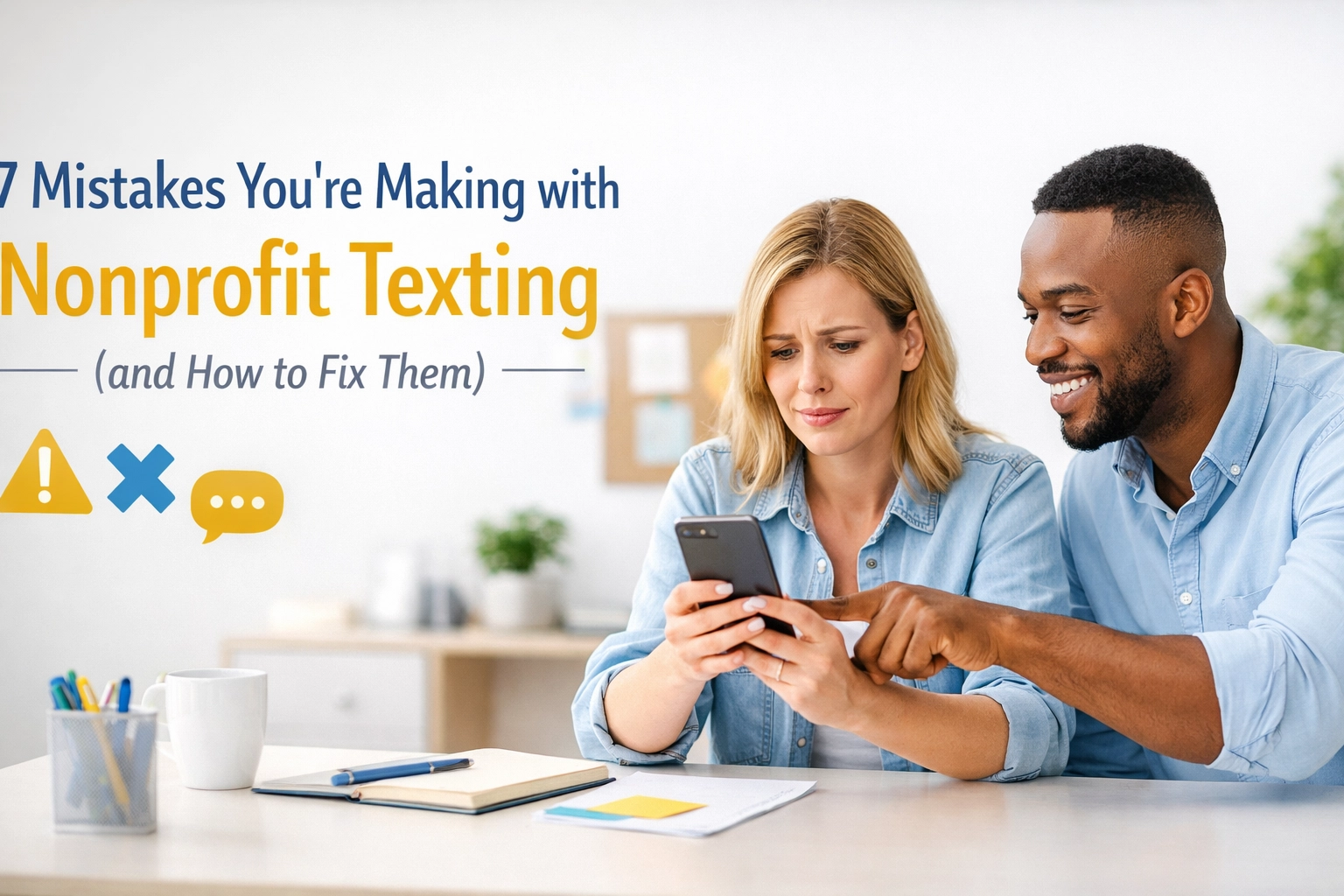
7 Mistakes You’re Making with Nonprofit Texting (and How to Fix Them)
Let’s be honest: your supporters’ phones are the most valuable real estate in the world. People might ignore a stack of mail on the kitchen counter or let an email sit unread in a "Promotions" tab for three weeks, but they almost always check a text message. In fact, research shows that SMS messages have an open rate of around 98%. That is a fundraiser's dream come true!
But here’s the catch. Because texting is so personal, it’s also very easy to mess up. One wrong move and you aren’t just "the charity I support", you’re "the annoying robot that won’t stop buzzing my pocket."
If your nonprofit is dipping its toes into the world of SMS fundraising, or if you’ve been doing it a while but aren’t seeing those 10% click-through rates everyone talks about, you might be falling into a few common traps. Don’t worry, we’ve all been there. At Donation Accelerator, we see these pitfalls all the time, and the good news is that they are all totally fixable.
Let’s break down the seven biggest mistakes nonprofits make with texting and how you can turn them around to build stronger donor relationships.
1. Texting Without a "Green Light" (Consent Issues)
The biggest mistake you can make isn’t just bad for your reputation, it can be bad for your legal standing. Texting people without explicit permission is a major violation of the Telephone Consumer Protection Act (TCPA). Even if someone gave you their phone number when they donated three years ago, that doesn't automatically mean you have the right to send them marketing texts.
The Fix: Always obtain implied or explicit consent. The easiest way to do this is by having a checkbox on your donation forms or event registration pages. Make it clear: "Check here to receive updates via text." You can also use a "Text-to-Join" campaign where supporters text a keyword like "IMPACT" to your shortcode.
Keeping accurate records of when and how people opted in is crucial. If you’re looking to streamline how you manage these permissions and the data behind them, check out our donor relationship manager software to keep everything organized and compliant.

2. Being a "Mystery Caller" (Lack of Identification)
Have you ever received a text from a random number saying, "Hey! Can you help us reach our goal by midnight?" Your first thought isn't "Let me grab my credit card." It’s "Who is this, and how did they get my number?"
If you don't identify your organization immediately, you trigger "stranger danger." Supporters are wary of scams, and a text from an unknown five-digit code or random 10-digit number feels suspicious.
The Fix: Every single text should start with your organization’s name. Even better, give it a human touch.
- Bad: "We need $500 more to save the park. Give here: [Link]"
- Good: "Hi Sarah, it's Harry from Donation Accelerator! We're just $500 away from our goal for the local park. Can you help?"
By identifying yourself right away, you build instant trust and remind the donor why they care about your cause in the first place.
3. The 3:00 AM Buzz (Poor Timing)
Timing is everything. Sending a heartfelt appeal about hungry puppies at 11:30 PM on a Tuesday is more likely to result in an "UNSUBSCRIBE" than a donation. People view their text inbox as a private space for friends and family. If you interrupt their sleep or a busy Monday morning meeting, you’re overstepping.
The Fix: Stick to the "Goldilocks Zone." Generally, the best times to text are between 9:00 AM and 8:00 PM in the recipient's local time zone. Avoid the early morning rush and late-night wind-downs.
If your donor base is spread across the country, make sure your texting platform allows you to segment by time zone. You don’t want to send a "Good Morning" text to your California donors at 6:00 AM just because it’s 9:00 AM at your headquarters in New York.
4. Treating Your Donors Like a Number (Generic Messaging)
One of the greatest strengths of AI-powered fundraising today is the ability to be personal at scale. If you are sending the exact same "Dear Friend" text to a first-time donor and a 10-year monthly giver, you’re missing a huge opportunity. Generic messages feel like spam. Personalized messages feel like a conversation.
The Fix: Use data to your advantage. At the very least, include the donor's first name. But don't stop there! Use segmenting to reference their specific interests.
- Example Script for a Past Donor: "Hi Mark! Thanks for supporting our clean water project last year. We’re starting a new well in Kenya today: want to see the progress?"
When supporters feel seen and valued, they are much more likely to engage. If you want to take this to the next level, our virtual agent call campaigns can actually follow up on these texts with personalized voice interactions, creating a multi-channel experience that really sticks.

5. The "Call to Action" Overload
We get it: you have a lot of great things happening! You want them to donate, sign a petition, watch a video, and volunteer for Saturday's gala. But if you put all of those links in one text, your donor will likely do… absolutely nothing. Choice paralysis is real.
The Fix: One text, one goal. If your goal is fundraising, focus entirely on that. If you want them to register for an event, focus on that. Keep your "Call to Action" (CTA) clear and singular.
Also, make sure your link is short. Use a URL shortener or a built-in tool from your SMS provider so the link doesn't take up three lines of text. A clean, single link is much more clickable than a cluttered mess of options.
6. Sending Donors to a "Broken" Page
Imagine this: Your text is perfect. The donor is inspired. They click the link… and they land on a website that was designed in 2005. They have to pinch and zoom to find the "Donate" button, the form has 25 required fields, and the "Submit" button doesn't work on Safari.
They’re going to close the tab, and you’ve lost that gift forever.
The Fix: Your donation page must be mobile-first. Since 100% of your SMS recipients are on a mobile device when they click your link, the landing page experience needs to be seamless.
- Keep forms short (Name, Email, Amount, Payment).
- Ensure buttons are large enough to tap with a thumb.
- Enable mobile wallets like Apple Pay or Google Pay to reduce friction.
If you aren't sure if your current site is up to snuff, you might want to look into integrating a website chatbot fundraiser that can guide donors through a simplified mobile giving process right then and there.

7. Making it Hard to Leave (The "Hotel California" Trap)
It sounds counterintuitive, but making it easy to opt-out actually builds trust. If a supporter wants to stop receiving texts and they can’t figure out how, they won’t just get annoyed: they’ll report your number as spam. If enough people do that, carriers (like Verizon or AT&T) might block your organization from sending texts altogether.
The Fix: Always include opt-out instructions, especially in your initial "Welcome" text and occasionally in your regular updates. A simple "Reply STOP to opt out" is the industry standard.
When someone does reply "STOP," make sure your system handles it immediately. Nothing kills a donor relationship faster than continuing to text someone after they’ve asked you to quit.
Bonus Tip: Use Scripts That Actually Work
Need some inspiration? Here are three quick scripts you can adapt for your nonprofit:
The "Thank You" (Non-Asks are vital!):
"Hi [Name], it's [Your Name] from [Org Name]. Just wanted to send a quick note to say your gift last week helped us buy 50 new books for the library. You're a hero! 📚"
The "Urgent Appeal":
"Hi [Name], [Org Name] here. We have an urgent situation: the shelter's heater just broke. We need $2k to fix it tonight. Can you chip in $25 to keep the pups warm? [Link]"
The "Event Reminder":
"Hey [Name]! Can't wait to see you at the Fun Run tomorrow at 9 AM. Need directions to the start line? Here you go: [Link]. See you there! – [Org Name]"
Wrapping It All Up
Texting is one of the most powerful tools in a modern fundraiser's toolkit. It’s fast, it’s direct, and it’s effective. By avoiding these seven common mistakes: like ignoring consent, poor timing, and lack of personalization: you can move away from "blasting" your donors and start truly connecting with them.
Remember, the goal of SMS isn't just to get a quick click; it's to build a long-term relationship. Treat your supporters' phones with respect, keep your messages human, and make the giving process as easy as possible.
Ready to supercharge your fundraising with AI and smart automation? Whether you're looking for planned giving solutions or want to see a demo of our virtual agents, Donation Accelerator is here to help you reach your goals.
Happy texting!