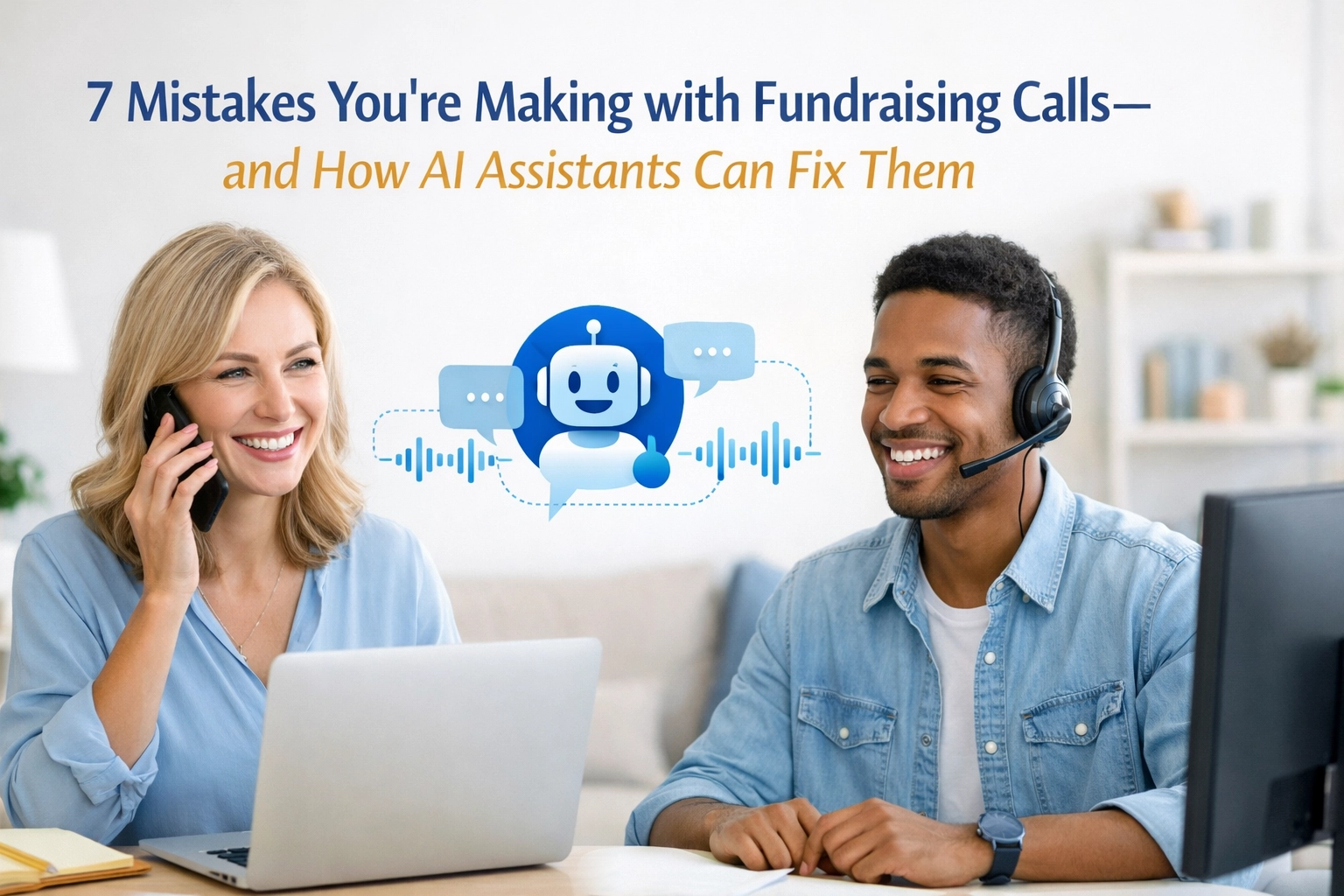
7 Mistakes You’re Making with Fundraising Calls, and How AI Assistants Can Fix Them
Let’s be honest: nobody likes a bad phone call. We’ve all been there, sitting down for dinner just as the phone rings with a generic, scripted pitch that feels about as personal as a grocery store receipt. For nonprofit professionals, the struggle is even more real. You know that personal connection is the "secret sauce" of fundraising, but your team is stretched thin, the donor list is growing, and there simply aren't enough hours in the day to call everyone.
Traditional phone marathons are exhausting. They lead to staff burnout, inconsistent messaging, and, worst of all, missed opportunities to connect with your supporters. But what if the problem isn’t the phone call itself? What if the problem is how we’re making them?
At Donation Accelerator, we’ve seen how technology can bridge the gap between "scaled outreach" and "personal touch." It turns out, many of the hurdles that make fundraising calls a headache can be cleared with a little help from AI.
Here are the seven most common mistakes nonprofits make with fundraising calls and how AI-powered virtual calling assistants can turn things around.
1. Calling at Inconsistent or Repetitive Times
We’ve all had that one solicitor who calls every Tuesday at 6:00 PM. By the third week, you aren’t just ignoring the call; you’re resenting the organization. Many nonprofits fall into the trap of "batch calling", hitting the phones whenever a volunteer or staff member has a free hour. This leads to calling the same people at the same time, often when they’re busy, stressed, or unavailable.
How AI Fixes It:
AI doesn't have a "shift." AI-powered assistants can analyze donor data to identify the best times to reach certain segments. More importantly, they can stagger calls intelligently. If a donor doesn't pick up on a Monday morning, the AI won't just blindly redial at the same time the next day. It uses smart scheduling to ensure you’re respecting the donor’s lifestyle, increasing the chances of a "Hello" instead of a "Decline."

2. Skipping the "Permission" Step
Imagine someone walking into your house and immediately starting a presentation about a new vacuum cleaner. That’s what it feels like when a fundraiser launches into a pitch without asking if the donor has a moment to talk. Because phone calls are inherently interruptive, jumping straight to the "ask" feels aggressive and disrespectful of the donor’s time.
How AI Fixes It:
Our virtual agent call campaigns are designed with digital etiquette at their core. An AI assistant can be programmed to always lead with a polite, "Is now a good time to chat for a moment?" If the answer is no, the AI can automatically offer to schedule a callback or send a follow-up text. This builds immediate trust and shows the donor that your organization values them as a person, not just a line item in a budget.
3. Using Vague, "One-Size-Fits-All" Scripts
"We help children in need." It’s a noble cause, but it’s also incredibly vague. When callers rely on generic scripts, the donor's eyes (and ears) glaze over. Donors want to know exactly where their money is going and what the specific impact will be. However, keeping track of every donor’s specific interests is a massive administrative burden for a human caller.
How AI Fixes It:
AI doesn't just read a script; it utilizes data. By integrating with your CRM, an AI assistant can pull specific details about a donor’s past giving history or expressed interests. Instead of a generic pitch, the AI can say, "Last year, your gift helped us provide 500 meals to the local shelter. This year, we’re looking to expand that to 1,000." This level of personalization at scale is impossible for a small team to do manually, but it’s exactly where AI excels.
4. Failing to Ask for a Specific Amount
One of the biggest mistakes in fundraising is the "Open-Ended Ask." Saying "Would you like to donate?" puts the mental burden on the donor to decide what's appropriate. Usually, this results in a lower gift or a "let me think about it" (which usually means "no").
How AI Fixes It:
AI assistants can calculate a "Suggested Gift Array" in real-time based on a donor’s previous behavior and demographic data. During the conversation, the AI can naturally suggest a specific amount: "Would you consider a gift of $75 today? That would cover the cost of one student’s supplies for the entire semester." By providing a concrete number linked to a concrete outcome, you make it much easier for the donor to say yes.
5. Creating a Monologue Instead of a Dialogue
We’ve all been on the receiving end of a "broadcast" call, where the person on the other end talks at you for three minutes straight without breathing. Effective fundraising is about building a relationship, and relationships require two-way communication. If your callers are too focused on getting through the script, they miss the cues that the donor actually wants to engage.
How AI Fixes It:
Modern AI utilizes Natural Language Processing (NLP). This means the assistant isn't just waiting for its turn to speak; it’s actually "listening" to the donor’s responses. If a donor mentions they’re worried about a specific issue, the AI can pivot the conversation to address that concern. This creates a genuine feeling of being heard. It turns a "robocall" into a virtual agent call campaign that feels like a real conversation.
6. The "Admin Nightmare" of Pledge Confirmation
Let’s say the call goes great and the donor pledges $100. Awesome! But then, the volunteer forgets to ask for their updated email address, or they misplace the sticky note with the pledge details. Suddenly, that $100 disappears into the ether because there was no proper follow-up. Human error in data entry is the silent killer of fundraising ROI.
How AI Fixes It:
The moment an AI assistant finishes a call, the data is synced. There’s no "wait until the end of the night to enter data." The AI confirms the pledge, verifies the payment method, and can even trigger an immediate "Thank You" email or text while the donor is still feeling the "giver's high." By automating the donor relationship management, you ensure that no pledge ever falls through the cracks.

7. Only Calling When You Want Money
This is perhaps the most common mistake of all. If the only time a donor hears from you is when your hand is out, they’ll start associating your organization with an "invoice" rather than a "cause." Stewardship is about the moments between the asks. But let’s be real: most nonprofits don't have the staff capacity to call 5,000 donors just to say "Thank You."
How AI Fixes It:
This is where AI truly shines for staff capacity. You can deploy AI assistants for "Gratitude Campaigns." Imagine every donor getting a personal phone call 24 hours after their donation just to say thanks and share a quick success story. Because the AI handles the volume, your human staff can focus their energy on high-level major donor relationships, while the AI ensures that the "broad base" of your donors feels seen and appreciated.
Scaling Your Impact Without Losing Your Soul
The fear around AI in fundraising is usually that it will feel cold or robotic. But in reality, the current system, overworked staff reading tired scripts to annoyed donors, is what feels robotic.
By using Donation Accelerator’s AI solutions, you aren't replacing the human element; you’re freeing up your humans to be more… well, human. When your AI handles the routine follow-ups, the pledge confirmations, and the initial outreach, your team can spend their time on the deep, strategic work that actually moves the needle.
Ready to see how a virtual agent can transform your next campaign? Check out our virtual agent call campaigns demo and see how we can help you scale your outreach without losing the personal touch that makes your nonprofit special.

Final Thoughts
Fundraising is changing. The organizations that thrive in the next few years will be those that figure out how to use technology to enhance human connection, not replace it. Don't let your team burn out on the phones. Stop making the "Big 7" mistakes and start using AI to build a donor experience that actually makes people glad they picked up the phone.
If you’re ready to take the next step, contact us today. We’d love to help you build a smarter, friendlier fundraising machine.